
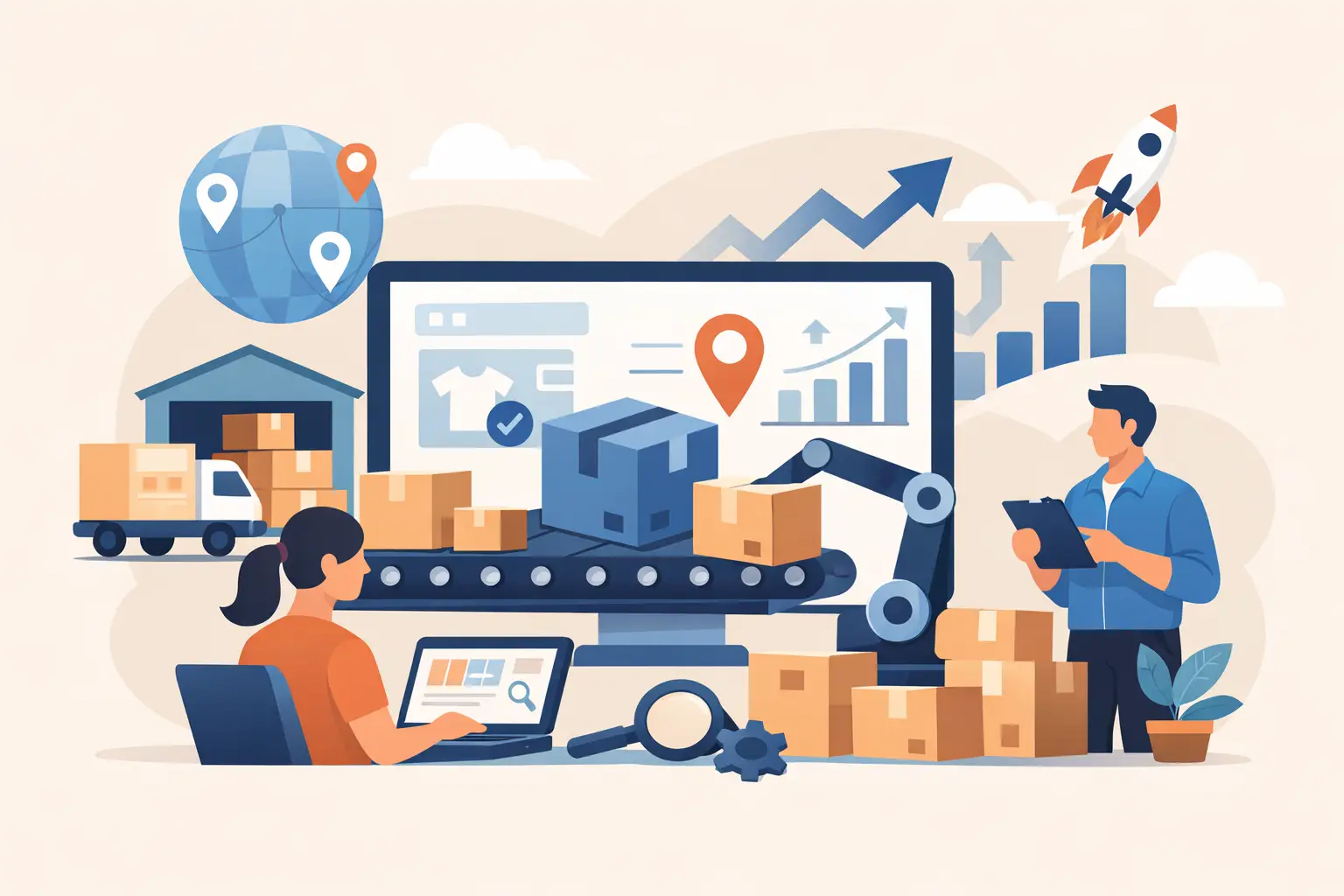
A late parcel rarely looks like a logistics problem to your customer. It looks like your business failed to deliver. That is why a good online seller fulfillment guide matters - not just for shipping orders, but for protecting margins, repeat sales, and your reputation.
For many sellers, fulfillment starts out simple. A few daily orders can be packed from home, stock can sit on a shelf, and customer messages can be handled manually. Then volume grows. Products multiply. Peak periods hit. Returns start piling up. What worked at 10 orders a day starts breaking at 50.
What an online seller fulfillment guide should actually help you solve
Fulfillment is not only about sending parcels. It covers the full chain between a customer placing an order and receiving the right item in acceptable time and condition. That includes inventory storage, picking, packing, labeling, handoff, tracking, delivery exceptions, returns, and sometimes self-collection.
The problem for online sellers is that each step affects cost and customer experience at the same time. If you pack slowly, labor costs rise. If you store stock poorly, mistakes increase. If your courier handoff is inconsistent, complaints go up. If your return process is messy, your team loses time fixing preventable issues.
A useful fulfillment setup should reduce friction across the operation. It should help you process orders accurately, keep delivery timelines realistic, and stay flexible when order volume changes.
Start with your order profile, not your ambition
Sellers often choose fulfillment based on where they want the business to be in a year. In practice, your current order profile matters more. A seller moving small beauty items nationwide has different needs from a merchant shipping large home goods or a business serving dense urban areas with urgent same-week delivery expectations.
Look at four things first: your average daily order volume, SKU count, parcel size variation, and where your customers are located. These factors shape almost every fulfillment decision. A low-SKU business with predictable volume can run lean with simple processes. A seller with hundreds of fast-moving items needs tighter stock control and more disciplined packing workflows.
There is also a trade-off between flexibility and efficiency. Handling everything yourself gives you control, but it also consumes time that could go into sales, sourcing, and customer retention. Outsourcing too early can add cost before the order volume justifies it. The right answer depends on what is slowing your business down now.
Inventory discipline is where fulfillment usually succeeds or fails
Most shipping problems start before packing. They start with inventory that is not where it should be, not counted correctly, or not organized for speed.
A practical inventory system does not need to be complicated, but it does need rules. Fast-selling items should be easy to access. Similar-looking products should not sit side by side without clear labeling. Bundle items should be mapped properly so your team does not forget one component. If stock is stored across multiple locations, there should be one clear source of truth for available units.
This is where many SMEs lose money quietly. Overselling creates customer service pressure and refund costs. Understocking loses sales. Poor slotting increases pick time on every order. Those small losses add up faster than most sellers expect.
If your team is spending too much time searching for products, recounting stock, or correcting packing mistakes, the issue is likely process design, not employee effort.
Packing is part of your cost structure
Packing is often treated as a basic task, but it directly affects labor cost, material cost, damage rates, and customer perception. Good packing should fit the product, protect it in transit, and avoid unnecessary material.
Oversized packaging increases dimensional weight and shipping cost. Weak packaging can lead to damaged items, claims, and replacements. Inconsistent packing standards also make training harder as your team grows.
The best approach is to create a small number of standard packing methods based on product type. Fragile items need one clear standard. Apparel may need another. Multi-item orders should follow a repeatable process that reduces missed pieces. If every packer uses their own judgment every time, errors become expensive.
For some sellers, packaging is also a branding touchpoint. That matters, but not every product needs premium presentation. If your buyers care most about speed and condition, practical packaging may serve your business better than expensive unboxing materials.
The online seller fulfillment guide to choosing the right operating model
There is no single model that fits every e-commerce business. Most online sellers work within one of three setups: self-fulfillment, hybrid fulfillment, or fully outsourced fulfillment.
Self-fulfillment works well when order volume is still manageable, products are straightforward, and founders want direct control. It is usually the cheapest option in the early stage, but the hidden cost is time. Once fulfillment starts taking over your day, growth can stall.
Hybrid fulfillment is often the most practical middle ground. You may keep slow-moving or special-handling inventory in-house while shifting routine order processing, drop-off coordination, or collection support to a logistics partner. This can improve speed without forcing a full operational handover.
Fully outsourced fulfillment makes sense when volume is high enough to justify it, when the seller needs wider geographic reach, or when internal space and labor are becoming constraints. The benefit is scalability. The trade-off is that your business becomes more dependent on your partner's accuracy, system visibility, and service response.
For sellers that need more than delivery alone, a broader logistics ecosystem can be especially useful. A setup that combines fulfillment, retail touchpoints, self-collection options, and business support services can reduce operational gaps that standard courier-only arrangements do not solve.
Delivery options shape customer trust
Customers do not all want the same thing. Some want home delivery. Some prefer collecting parcels near where they live or work. Some care more about price than speed. Others will pay for convenience. Fulfillment performs better when delivery options match real customer behavior.
This is especially relevant for sellers serving mixed customer segments. Failed delivery attempts create cost. Missed parcels create frustration. Giving buyers a reliable collection option can reduce both, especially in areas where delivery timing is harder to predict.
That is one reason many businesses now look beyond a single courier relationship. A partner with both digital coordination and local station support can offer more flexibility at the last mile. For growing merchants, that flexibility is operational, not cosmetic.
Returns should be designed before they become a problem
Many sellers treat returns as an afterthought because they focus on outbound orders. That usually works until return volume increases and starts distracting the team.
A practical return process should answer a few basic questions clearly. Where does the item go? How is it checked? When is it restocked, rejected, or replaced? Who updates the system? If these steps are unclear, returned inventory becomes dead stock and customer service cases drag on.
Not every business needs a highly advanced reverse logistics setup, but every business needs a documented one. Even a simple process is better than an improvised one.
When to change your fulfillment setup
A lot of sellers wait too long to upgrade operations because the current system still technically works. The better question is whether it still works profitably.
If your team regularly ships late, if order errors are becoming normal, if storage is eating into working space, or if customer service is spending too much time on delivery issues, your fulfillment model may already be limiting growth. Another warning sign is founder dependency. If orders cannot move properly unless the owner is personally involved every day, the business is carrying operational risk.
This is usually the point where process support matters more than effort. A dependable partner can help reduce manual handling, improve delivery access, and give sellers a more stable base for scaling. For businesses that want both logistics support and practical access points for sending and collection, iExpress is built around that operating reality.
What good fulfillment looks like in practice
A strong fulfillment operation is not flashy. Orders flow in cleanly. Inventory is visible. Packing is consistent. Parcels move out on time. Collection and delivery options are clear. Problems are easier to spot and fix because the system is not held together by guesswork.
That kind of setup gives online sellers something valuable: room to focus on the business itself. You can spend more time improving product range, marketing, and customer retention when fulfillment is stable in the background.
If you are reviewing your own operation, start with where friction is already costing you money or credibility. Fix that first. Fulfillment does not need to be perfect to support growth, but it does need to be deliberate. The sellers who scale well are usually the ones who stop treating fulfillment as a back-office task and start managing it like a real part of the customer experience.